The movement is the part I keep coming back to.
I love the idea that a mechanical watch works without a battery. A small spring stores energy, an intricate system of gears transfers it, and a balance oscillates to regulate how quickly it is released. Watching that happen through an exhibition caseback never gets old for me.
The more watches I assembled, the more I understood that the movement isn't simply another part in a shopping list. Fitting a dial, adjusting a stem, setting the hands and checking a watch over time taught me how much precision goes into something most people never see.
Mechanical watches aren't necessarily more accurate than quartz watches. What fascinates me is how they achieve their function with moving parts—and how much there still is for me to learn.

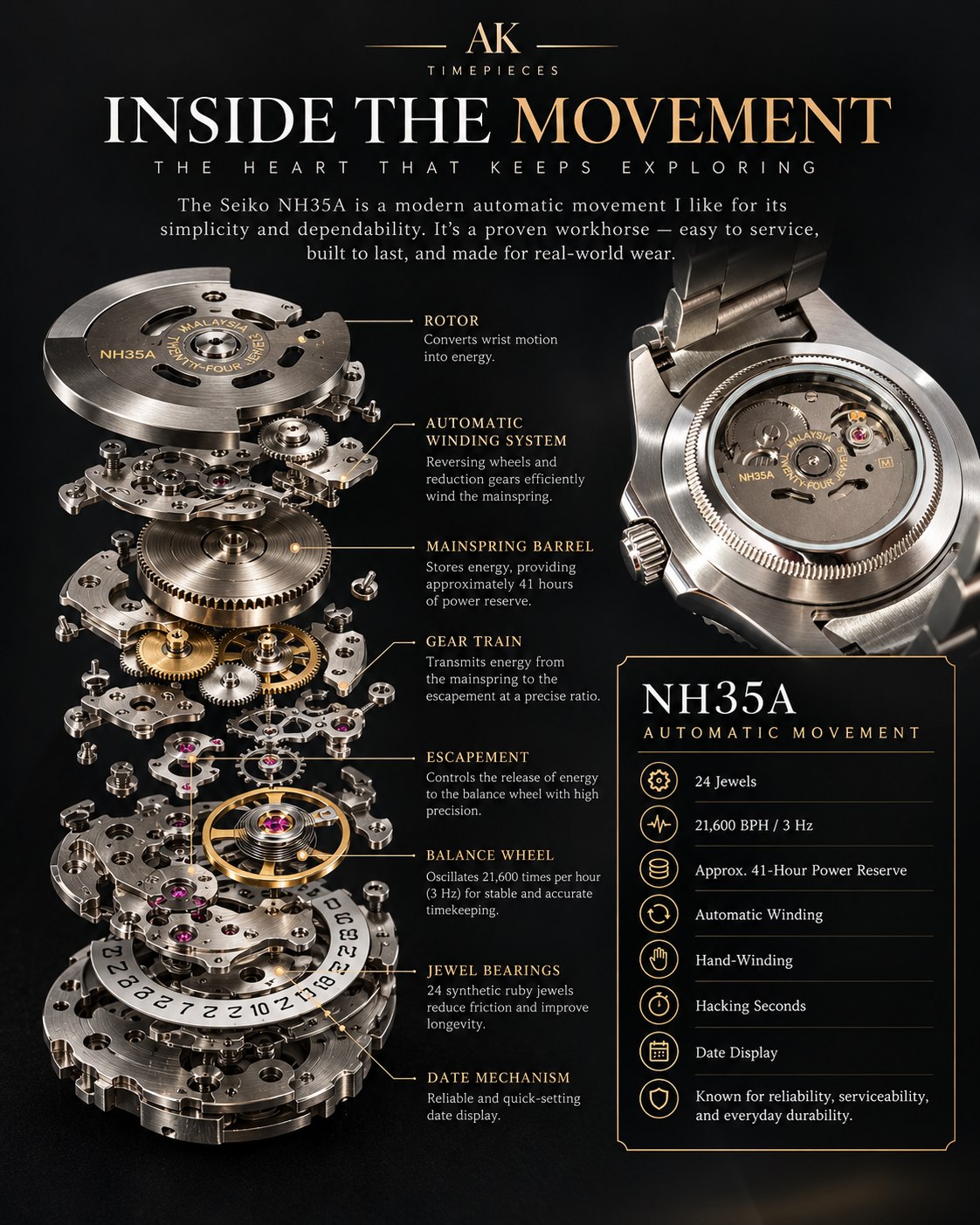
What sits inside an automatic watch?
This illustrative breakdown makes the main groups easier to picture: a winding rotor, stored energy in the mainspring, the gear train, an escapement, and the oscillating balance.
Conceptual educational art, not a technical exploded-view specification of the NH35. Refer to the NH35 manufacturer's documentation for exact component design and tolerances.
How an automatic watch works
This is a simplified explanation of the energy path inside an automatic movement—not a literal parts-placement diagram.
Rotor
Wrist movement swings a weighted rotor, helping wind the mainspring.
Mainspring
A coiled spring stores the energy that will power the watch.
Gear train
Gears carry energy through the movement and drive the time display.
Escapement & balance
The balance oscillates and the escapement meters out energy.
A mechanical watch, layer by layer.
What keeps it moving?
I was fascinated by the idea that a watch can store energy from everyday movement and release it through a carefully regulated mechanical system. That's what led me from collecting watches to working on the movements themselves.
Rotor: motion helps wind the mainspring. Barrel: the mainspring stores energy. Gear train: transmits controlled power. Escapement and balance: regulate the release of that energy.
The figures below describe the standard NH35A movement, not guaranteed performance of any particular assembled watch.
Explore NH35 specifications ↓Inside the NH35
A practical movement that earned my trust.
I began my watch-building experiments with a variety of movements. Some inexpensive examples created more problems than they solved. Working with genuine NH35 movements gave me a better experience and helped me put more attention into the design and assembly rather than constant troubleshooting.
That is why the NH35 has become one of my preferred choices for projects intended to become finished watches. I like its straightforward functionality: automatic winding, manual winding, a stop-seconds function for setting the time and a familiar three-hand/date layout.
It's a dependable starting point for my kind of small-batch watch assembly. As with any mechanical movement, actual accuracy and running time vary with the individual watch, its winding and how it is worn.
NH35A
- Type
- Automatic + manual winding
- Functions
- Hours, minutes, seconds, date
- Jewels
- 24
- Frequency
- 21,600 vibrations/hour (3 Hz)
- Duration*
- More than 41 hours when fully wound
- Stop-seconds
- Yes
- Movement height
- 5.32 mm
*Manufacturer specification for the movement under specified test conditions, not a measured guarantee for an individual assembled watch.
Read official TMI specifications ↗I'd rather build carefully than build quickly.
Choosing components is only the beginning. I enjoy understanding what happens between them: how a movement sits in a case, how the hands clear the dial, whether the winding feels smooth, and how the watch behaves after it has been running. That curiosity is the reason AK Timepieces exists.
Read my story → Explore my watches →